
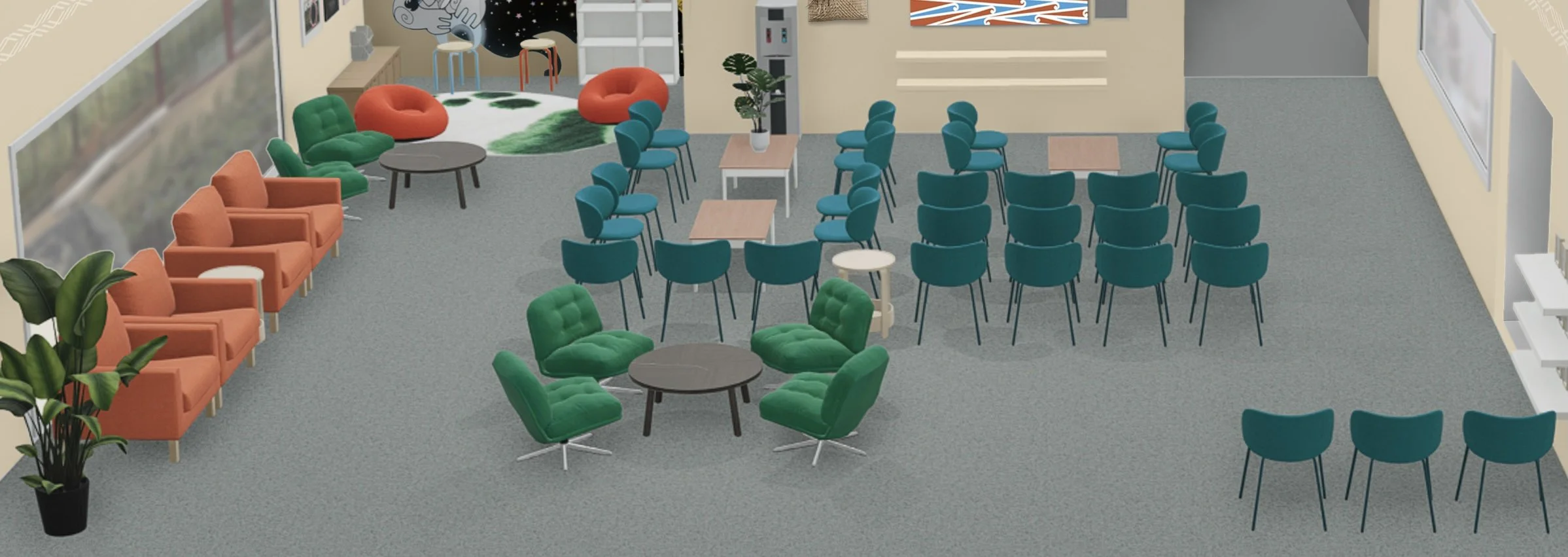
Making space for equity
Culture-centred design of hospital waiting rooms
Hospitals in Aotearoa New Zealand have a legacy founded in colonialism and are designed to Eurocentric principles of health and well-being – as such they are inequitable by design and represent culturally unsafe spaces for many people who need to access them. This includes hospital waiting rooms. Most people going to hospital will head to a waiting room. They function as a holding space (mechanism). Most are utilitarian, uncomfortable, impersonal and clinical. Our project is premised on understanding how physical spaces in hospitals shape people’s experiences of care. While we are not able to change why people need to attend hospital, we can positively shape their experience of it.
Integral to a culture-centred design process is epistemic justice. In the context of hospitals, who has a say in the ideas for and creation of hospital waiting room design (and which people are excluded)? What are the power relations and how are they reproduced in and through the design? Which (normative) concepts are used and which ones not?
-
There is often an expectation that people need certain information to understand their condition and/or to make informed choices about treatments. But who makes the decision about what information counts as important, and how this is communicated? If people do not have access to information such that it makes sense to and for them, it can exclude people from their healthcare, or to seek care. What constitutes information as being relevant is often decided by and through the healthcare systems. This has the effect of excluding knowledge and information that comes from non-western / biomedical knowledge. Knowledge is not power. Power is about who gets to decide whose, and what, knowledge is deemed important.
Culturally centred co-design is collaborative design that is community and user driven. Rather than relying on traditionally extractive academic processes, it is inherently inclusive, and involves learning about, and working alongside communities to prioritise local, lived knowledge and experience.
Our co-designed resources are Know Your Period and Colp 101.
-
Current undergraduate medical education gives priority to certain social norms. Often this means that representation of people with intersecting, multiple, marginalised identities (e.g., young/old age, gender, LGBTQIAT+, ethnicity, disability, social disadvantage, big bodied…..) is not well/under-represented in medical curricula, or in the learning environment. This represents two injustices and contributes to inequity in access to cultural safe and inclusive care. One injustice is that doctors with diverse and intersecting social identities are invisible in the learning environment, and the second, that doctors are not well prepared to care for people with diverse social identities. Doctor preparedness for working with gender and sexuality diversity is internationally recognised as an essential practice competency which needs to include undergraduate medical education. However, this is not the current norm.
Co-operative inquiry is a well-established qualitative participatory action research method. It involves a collaborative approach to generating knowledge where people with common interests or shared concerns come together as both co-researchers and co-participants
Our co-operative inquiry approach for gender and sexuality diversity is Beyond Binary.
-
Hospitals in Aotearoa New Zealand have a legacy founded in colonialism and are designed to Eurocentric principles of health and well-being – as such they are inequitable by design and represent culturally unsafe spaces for many people who need to access them. This includes hospital waiting rooms. Most people going to hospital will head to a waiting room. They function as a holding space (mechanism). Most are utilitarian, uncomfortable, impersonal and clinical. Our project is premised on understanding how physical spaces in hospitals shape people’s experiences of care. While we are not able to change why people need to attend hospital, we can positively shape their experience of it.
Integral to a culture-centred design process is epistemic justice. In the context of hospitals, who has a say in the ideas for and creation of hospital waiting room design (and which people are excluded)? What are the power relations and how are they reproduced in and through the design? Which (normative) concepts are used and which ones not?
Our culture-centred design inquiry approach for hospital waiting rooms is Building equity.
-
Genomic medicine is a complex area. It is a technology which can screen someone’s entire DNA sequence. In the context of prospective parenthood, people can be in the position of deciding to have this type of screening. As participating in genomic medicine (as healthcare consumers and/or in research) grows it is essential that people’s agency and epistemic credibility are upheld; for example, in research that explores the use of decision aides, uptake of screening or testing, preferences for how any findings from testing or screening are returned.
In Western society, education and employment are often viewed as indicators of intelligence and/or social status. Such epistemic positioning could be conferred to people in practice, affecting what or how information is shared, or not, by a practitioner based on assumptions about someone’s ability to ‘understand’ because of their educational attainment (or other characteristic). Education and employment status would better used as contextual variables for, indicators of, social privilege within the biomedical hegemony. Race is a social construct premised on colonial and imperial thinkings, and used as a, albeit poor, proxy for social class, culture and genes.
Describing or reporting findings by, or to, ethnicity/race, also has the added potential to marginalise (racialise); positioning people as the ‘problem’ rather than history (e.g., colonisation), social structure (e.g., privileging whiteness), or organisational racism that prevents equal access to health care, and education.
The voice of lived experienceThe story you want people to hear and feel in this place is:
“I am safe and this is a safe place”.
Tangata whaiora at a community colposcopy clinic
Get in touch.
This website is a resource that’s in ongoing development.
We’d love to hear any thoughts about the content of the website. For example – what you have found most useful, what you’d like to hear more about, or if there are any projects you’d like to get involved with.